SENECA LAKE • LOCAL PROPERTY GUIDE
Seneca Lake
Property Taxes & Local Rules
A practical guide to Seneca Lake’s shoreline communities, property taxes, rental and zoning questions, septic systems, water supplies, propane tanks and dock permits.
Know your property. Know where to turn.
Lake-home ownership brings questions that cross municipal and county boundaries. This guide helps you identify the governments responsible for your Seneca Lake property, find official tax and land-use resources, and understand what to check before buying, selling, renovating, renting or undertaking shoreline work.
Explore the shoreline map and local municipality entries, then review septic inspections, drinking-water sources and dock permitting. Requirements depend on the exact parcel, its existing systems and your proposed use.
A starting point for your own due diligence
This guide is general information, not legal, tax, engineering or public-health advice, and it cannot establish whether a particular property complies. Rules and agency guidance can change. Before committing to a purchase or project, confirm current requirements directly with the municipal code or zoning officer, county Environmental Health office, assessor or tax collector, and—where applicable—NYSDEC and the Army Corps of Engineers. Obtain property-specific advice from your attorney and qualified septic, well or design professionals; request records and written approvals when needed.
Municipal map
Find your shoreline location.
Property taxes
Bills, assessments & county resources.
Local rules
Town, village & city guidance.
Docks & permits
Plan your shoreline project.
Septic inspections
Routine checks, sales & permits.
Water supplies
Public water, wells & lake intakes.
Start with the exact property
A mailing address does not always identify the government responsible for a property. Start with the county parcel record, then confirm the town or city, any village jurisdiction, school district and zoning district.
This guide focuses on shoreline municipalities, rather than every community in Seneca Lake’s much larger watershed. Expand an entry below for official sources and rental guidance.
Find your place on Seneca Lake
Explore the shoreline communities of Seneca Lake across Ontario County, Yates County, Seneca County, Schuyler County.
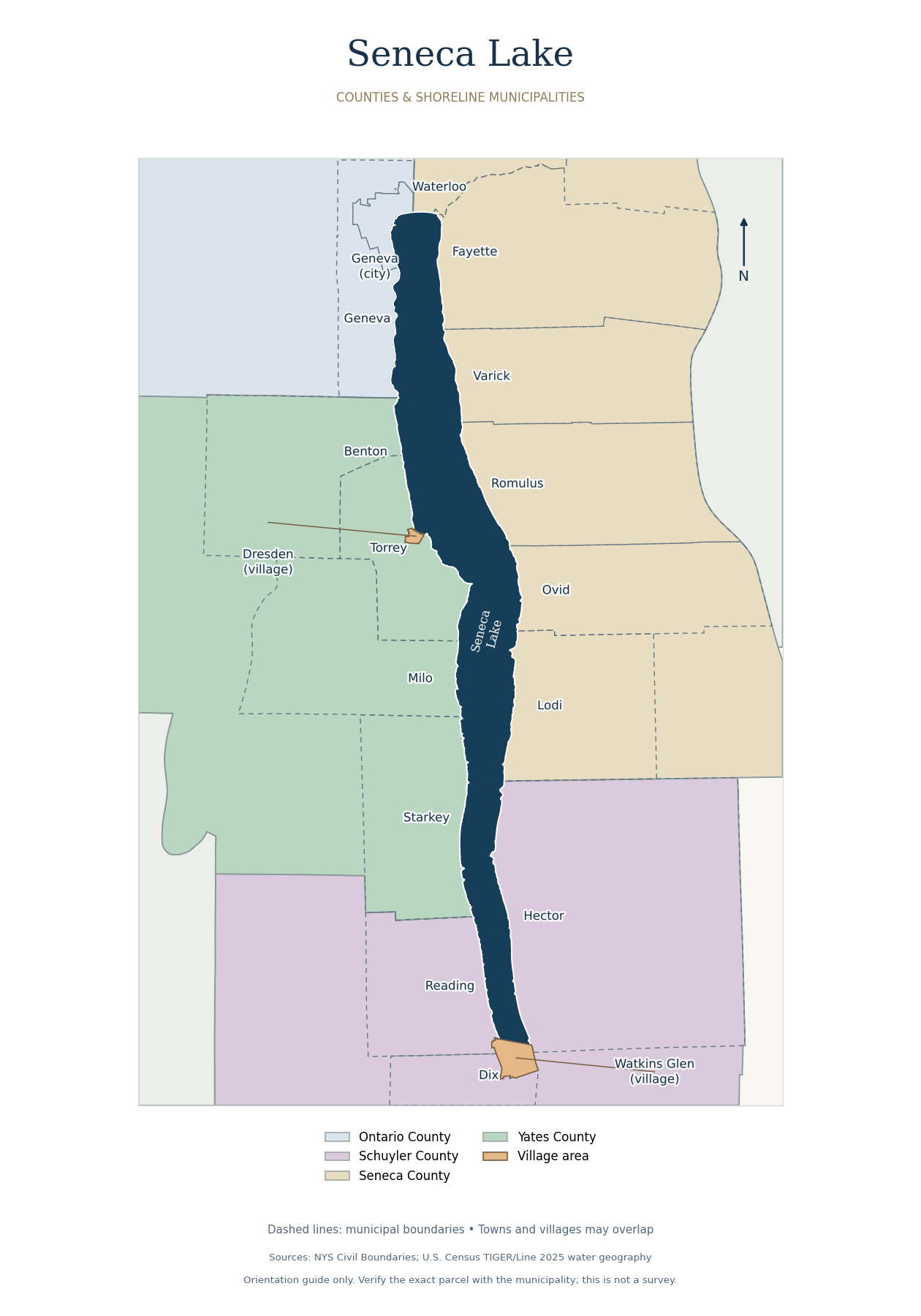
County links take you to the local guidance below. Tap the map to enlarge the boundaries and village labels.
Explore shoreline communities
Use county parcel records to confirm your property’s town, village or city. Village and town jurisdictions can overlap.
Map sources: NYS civil boundaries (March 2026) and U.S. Census TIGER/Line 2025 water geography.
This is an orientation map, not a property survey or a legal boundary determination.
The property-tax picture
Compare the property’s county, town or city, school, village and special-district charges. Properties in the same town can have different school districts, exemptions and service districts.
Start with the latest bills and assessment record. A seller’s bill is useful history, but exemptions or future assessment changes can affect what a new owner pays.
New York property-tax bills explained · New-homebuyer assessment guidance
Find your shoreline municipality
Ontario County · Yates County · Seneca County · Schuyler County
Seneca Lake’s shoreline crosses four counties. Geneva’s city jurisdiction is separate from the Town of Geneva; the city also includes territory in Seneca County. Dresden and Watkins Glen have village responsibilities in addition to their towns. The villages of Lodi, Ovid and Waterloo are inland.
Ontario County
Town of Geneva · City of Geneva
Rental & land use: Current short-term rental eligibility and detailed operating rules have not been confirmed here. Before advertising or purchasing for rental use, ask the municipality about zoning, registration, permits, safety inspections, occupancy and lodging taxes.
Property taxes: Ontario County tax/parcel resources. Confirm the tax-map ID, assessment, school district, exemptions and actual tax bills.
Rental & land use: Current short-term rental eligibility and detailed operating rules have not been confirmed here. Before advertising or purchasing for rental use, ask the municipality about zoning, registration, permits, safety inspections, occupancy and lodging taxes.
Geneva’s city boundary is separate from the Town of Geneva and extends into both Ontario and Seneca counties. Confirm the parcel’s county and city assessment record.
Property taxes: Ontario County tax/parcel resources. Confirm the tax-map ID, assessment, school district, exemptions and actual tax bills.
Yates County
Town of Benton · Town of Milo · Town of Starkey · Town of Torrey · Village of Dresden
Rental & land use: Current short-term rental eligibility and detailed operating rules have not been confirmed here. Before advertising or purchasing for rental use, ask the municipality about zoning, registration, permits, safety inspections, occupancy and lodging taxes.
Property taxes: Yates County tax/parcel resources. Confirm the tax-map ID, assessment, school district, exemptions and actual tax bills.
Rental & land use: Current short-term rental eligibility and detailed operating rules have not been confirmed here. Before advertising or purchasing for rental use, ask the municipality about zoning, registration, permits, safety inspections, occupancy and lodging taxes.
Property taxes: Yates County tax/parcel resources. Confirm the tax-map ID, assessment, school district, exemptions and actual tax bills.
Rental & land use: Current short-term rental eligibility and detailed operating rules have not been confirmed here. Before advertising or purchasing for rental use, ask the municipality about zoning, registration, permits, safety inspections, occupancy and lodging taxes.
Property taxes: Yates County tax/parcel resources. Confirm the tax-map ID, assessment, school district, exemptions and actual tax bills.
Rental & land use: Current short-term rental eligibility and detailed operating rules have not been confirmed here. Before advertising or purchasing for rental use, ask the municipality about zoning, registration, permits, safety inspections, occupancy and lodging taxes.
Property taxes: Yates County tax/parcel resources. Confirm the tax-map ID, assessment, school district, exemptions and actual tax bills.
Rental & land use: Current short-term rental eligibility and detailed operating rules have not been confirmed here. Before advertising or purchasing for rental use, ask the municipality about zoning, registration, permits, safety inspections, occupancy and lodging taxes.
Check village rules separately from town responsibilities. A village mailing address does not necessarily mean the parcel lies within the village.
Property taxes: Yates County tax/parcel resources. Confirm the tax-map ID, assessment, school district, exemptions and actual tax bills.
Seneca County
Town of Fayette · Town of Lodi · Town of Ovid · Town of Romulus · Town of Varick · Town of Waterloo · City of Geneva
Rental & land use: Current short-term rental eligibility and detailed operating rules have not been confirmed here. Before advertising or purchasing for rental use, ask the municipality about zoning, registration, permits, safety inspections, occupancy and lodging taxes.
Property taxes: Seneca County tax/parcel resources. Confirm the tax-map ID, assessment, school district, exemptions and actual tax bills.
Rental & land use: Current short-term rental eligibility and detailed operating rules have not been confirmed here. Before advertising or purchasing for rental use, ask the municipality about zoning, registration, permits, safety inspections, occupancy and lodging taxes.
Property taxes: Seneca County tax/parcel resources. Confirm the tax-map ID, assessment, school district, exemptions and actual tax bills.
Rental & land use: Current short-term rental eligibility and detailed operating rules have not been confirmed here. Before advertising or purchasing for rental use, ask the municipality about zoning, registration, permits, safety inspections, occupancy and lodging taxes.
Property taxes: Seneca County tax/parcel resources. Confirm the tax-map ID, assessment, school district, exemptions and actual tax bills.
Rental & land use: Current short-term rental eligibility and detailed operating rules have not been confirmed here. Before advertising or purchasing for rental use, ask the municipality about zoning, registration, permits, safety inspections, occupancy and lodging taxes.
Property taxes: Seneca County tax/parcel resources. Confirm the tax-map ID, assessment, school district, exemptions and actual tax bills.
Rental & land use: Varick publishes a short-term rental permit program. Ask about the current lakeshore permit cap, waitlist, owner-occupied options and transfer restrictions; confirm eligibility before relying on rental income.
Property taxes: Seneca County tax/parcel resources. Confirm the tax-map ID, assessment, school district, exemptions and actual tax bills.
Rental & land use: Current short-term rental eligibility and detailed operating rules have not been confirmed here. Before advertising or purchasing for rental use, ask the municipality about zoning, registration, permits, safety inspections, occupancy and lodging taxes.
Property taxes: Seneca County tax/parcel resources. Confirm the tax-map ID, assessment, school district, exemptions and actual tax bills.
Rental & land use: Current short-term rental eligibility and detailed operating rules have not been confirmed here. Before advertising or purchasing for rental use, ask the municipality about zoning, registration, permits, safety inspections, occupancy and lodging taxes.
Geneva’s city boundary is separate from the Town of Geneva and extends into both Ontario and Seneca counties. Confirm the parcel’s county and city assessment record.
Property taxes: Seneca County tax/parcel resources. Confirm the tax-map ID, assessment, school district, exemptions and actual tax bills.
Schuyler County
Town of Dix · Town of Hector · Town of Reading · Village of Watkins Glen
Rental & land use: Current short-term rental eligibility and detailed operating rules have not been confirmed here. Before advertising or purchasing for rental use, ask the municipality about zoning, registration, permits, safety inspections, occupancy and lodging taxes.
Property taxes: Schuyler County tax/parcel resources. Confirm the tax-map ID, assessment, school district, exemptions and actual tax bills.
Rental & land use: Current short-term rental eligibility and detailed operating rules have not been confirmed here. Before advertising or purchasing for rental use, ask the municipality about zoning, registration, permits, safety inspections, occupancy and lodging taxes.
Property taxes: Schuyler County tax/parcel resources. Confirm the tax-map ID, assessment, school district, exemptions and actual tax bills.
Rental & land use: Current short-term rental eligibility and detailed operating rules have not been confirmed here. Before advertising or purchasing for rental use, ask the municipality about zoning, registration, permits, safety inspections, occupancy and lodging taxes.
Property taxes: Schuyler County tax/parcel resources. Confirm the tax-map ID, assessment, school district, exemptions and actual tax bills.
Rental & land use: Current short-term rental eligibility and detailed operating rules have not been confirmed here. Before advertising or purchasing for rental use, ask the municipality about zoning, registration, permits, safety inspections, occupancy and lodging taxes.
Check village rules separately from town responsibilities. A village mailing address does not necessarily mean the parcel lies within the village.
Property taxes: Schuyler County tax/parcel resources. Confirm the tax-map ID, assessment, school district, exemptions and actual tax bills.
Septic Systems & Inspections
Start with the property’s actual wastewater arrangement: public sewer, septic, a treatment unit or a holding tank. The inspection program and review process depend on the county, municipality, system and planned use. Arrange any sale-related inspection early.
Routine inspections: Covered onsite systems serving properties with any part of the parcel within 250 feet of Seneca Lake are subject to a five-year inspection cycle. The published schedule is staggered by town. Confirm the parcel’s deadline and any applicable waiver with Environmental Health.
When ownership changes: The county law separately requires a property-transfer inspection for covered onsite systems, including properties outside the waterfront inspection area. Pumping follows the initial inspection; the law provides an exception where qualifying pumping within the preceding 12 months is documented. Confirm compliance and required paperwork before closing. Properties connected to municipal sewer are outside this septic law’s scope.
Seneca County inspection guidance · Watershed Protection Law
Schuyler’s Watershed Protection Agency administers real-property-transfer septic inspections. Contact the agency early to confirm the inspection scope, current policy, inspector and pumping arrangements for the property.
Do not apply Seneca County’s five-year rule to a parcel in another county. Ask the local code officer and responsible health authority about installation approvals, sale-related inspections and any municipal wastewater law. Ontario County Soil & Water Conservation District provides onsite-system services; confirm coverage for the exact municipality.
Ontario County onsite-wastewater services · Yates County official resources
Before buying, selling or changing use: Request the system’s approved design, permits, inspection reports, pumping records and any unresolved violations. Confirm approved capacity, the inspection deadline and required closing documents. Ask the county and local code officer how additional bedrooms, rental occupancy or conversion from seasonal to year-round use could affect approvals.
Wells, Public Water & Lake-Water Supplies
Confirm where the home’s water comes from, how it is treated and who is responsible for maintaining it. Water-supply questions belong alongside septic review: system location, water quality and intended household use can all affect a property’s suitability.
Ask the water provider to confirm that the property is connected, the service arrangements and any connection or upgrade requirements. Review the supplier’s annual drinking-water quality report for its source and test results.
A regulated public system may draw from a lake and treat and monitor that water. A private household lake intake needs its own assessment.
Request well construction records, recent laboratory results and treatment-system maintenance records. Ask county Environmental Health about appropriate testing, approved construction and separation from septic systems.
NYS Department of Health recommends testing private wells for coliform bacteria at least annually. Ask a certified laboratory or the health department which additional tests suit the property; one test result does not establish that water will remain safe.
Identify whether lake water supplies drinking water, cooking, bathing or only outdoor uses, and document the intake and treatment equipment. Ask county Environmental Health about acceptable uses, treatment, testing and approvals before relying on the system.
Untreated surface water can contain pathogens. Harmful algal blooms can introduce toxins, and common household treatment methods may not remove them. Boiling is not a reliable way to remove algal toxins. Seek health-department guidance rather than assuming clear-looking water or a household filter establishes safety.
NYS health guidance on harmful algal blooms & drinking water
Docks, Shoreline Work & Permits
A dock is part of lake life—and one of the first things owners ask about. Before building, enlarging or replacing one, check the rules for your shoreline parcel, the proposed design and the work in the water.
There is no single lake-wide approval. Local zoning, state environmental permits and federal authorization are separate checks. An exemption from one does not settle the others.
Local municipality
Start with zoning, setbacks and your exact parcel.
NYSDEC
Check state environmental permits and exemptions.
Army Corps
Confirm federal authorization for work in the lake.
Shoreline rules differ among Seneca’s towns, city and villages. Ask about water-rights lines, permitted dimensions, setbacks, boat lifts, covered structures and seasonal reinstallation. A nearby property’s dock is not proof that the same design is allowed on yours.
Varick’s published zoning code provides one municipal example; use the community links above for the actual parcel.
DEC’s Protection of Waters program regulates docks and moorings in navigable waters. Its dock exemption generally covers facilities accommodating five or fewer boats with a facility perimeter under 4,000 square feet. The perimeter includes related open-water berthing areas and lanes—not just the deck.
Ordinary maintenance may be exempt, but reconstruction involving 50% or more of a structure is not ordinary maintenance under this guidance. Dredging, placing fill and work affecting wetlands can need separate review.
DEC Protection of Waters: regulated activities and exemptions
The 4,000-square-foot facility perimeter relates to the dock exemption above. DEC’s Lakes and Shorelines General Permit GP-0-25-007 has a different pathway for certain projects, including qualifying residential docks with up to 400 square feet of deck surface, subject to construction and site conditions.
The 400-square-foot figure is an eligibility condition for that general permit, not a universal dock-size limit. Have DEC confirm the appropriate route before treating either number as permission to build.
The Buffalo District’s current list includes the entire Seneca Lake under Section 10. Obtain federal review for proposed work in, over or under its navigable waters; dredged or fill material can also require Section 404 authorization.
A local approval or DEC exemption does not resolve federal requirements. Keep the agency’s written determination.
A permit does not settle ownership, easements or a neighbor’s water-access rights. Ask whether the project uses state-owned underwater land and requires Office of General Services approval. Canal Corporation permissions may apply when work involves its property or canal jurisdiction; confirm the responsible agency for the actual site.
Before you order materials
- Identify the parcel: address, tax-map ID, municipality and shoreline ownership or access rights.
- Sketch the project: existing and proposed dimensions, boat count, lifts, supports, setbacks and any dredging, excavation or fill.
- Describe the work: new installation, ordinary repair, major replacement or expansion; include photos and previous permits.
- Confirm the approval path: local code officer, DEC regional permit office and Army Corps Buffalo District; keep written determinations and permit conditions.
DEC contacts: Ontario County — Region 8; Yates County — Region 8; Seneca County — Region 8; Schuyler County — Region 8. Find your DEC regional office
Reviewed October 7, 2026. The responsible agencies must confirm requirements for your project.
Propane Tanks & Fuel Systems
Propane equipment can raise permitting, placement and ownership questions for a lake home. Before buying, changing suppliers or planning an installation, review the setup with the local code or fire official and a qualified propane professional.
New York’s Fire Code addresses propane (LP-gas) storage and installation in Chapter 61, together with the Fuel Gas Code and NFPA 58. Ask the local code or fire official which permits and inspections apply before installing, moving or replacing a tank. Where an installation permit is required, the distributor must have that permit issued for the location before filling.
Required separation depends on tank capacity, installation type and nearby features. Have a qualified installer confirm the approved location relative to buildings, property lines, openings and ignition sources. Underground tanks also have specific placement requirements; do not use one blanket setback for every tank.
Ask the installer and local official to evaluate flood exposure, slopes, retaining walls, vehicle protection and delivery access. Confirm whether screening, nearby landscaping or a proposed addition would interfere with required clearances or service access.
For an existing installation, request permit and inspection records and ask the supplier to assess the tank, piping and equipment. Buried tanks warrant questions about location records, corrosion protection and maintenance obligations.
Verify whether the tank is owned by the homeowner or leased from a fuel supplier. Request the agreement and ask about transfer consent, supplier restrictions, fees, removal obligations and treatment of remaining fuel at closing. Have your attorney address those arrangements in the transaction.
Confirm the responsible supplier and service history before assuming that the equipment transfers with the home.
Other details worth checking
Building & zoning: Confirm setbacks, lot coverage, height, additions, decks, accessory structures and existing nonconforming uses with the local code officer.
Floodplain & access: Check flood-map status, local requirements, recorded shoreline rights, easements and private-road or association obligations.
About this guide
Sources reviewed October 7, 2026. This guide links to official municipal, county, inspection-program, NYS and federal resources. Shoreline coverage uses NYS civil boundaries with U.S. Census water geography. The map is for orientation; village and town jurisdictions can overlap.
Septic and docking guidance is tailored to Seneca Lake. Where an inspection interval, rental restriction or local dock limit has not been verified, confirm it directly before proceeding. Proposed laws are distinguished from adopted requirements.
Water and propane guidance provides questions to take to the responsible health, code and fire officials. Requirements, permits and site conditions must be checked for the exact property.
Have a question about your lake home?
I can help you identify the right local resources and questions to ask as you plan your next step.